
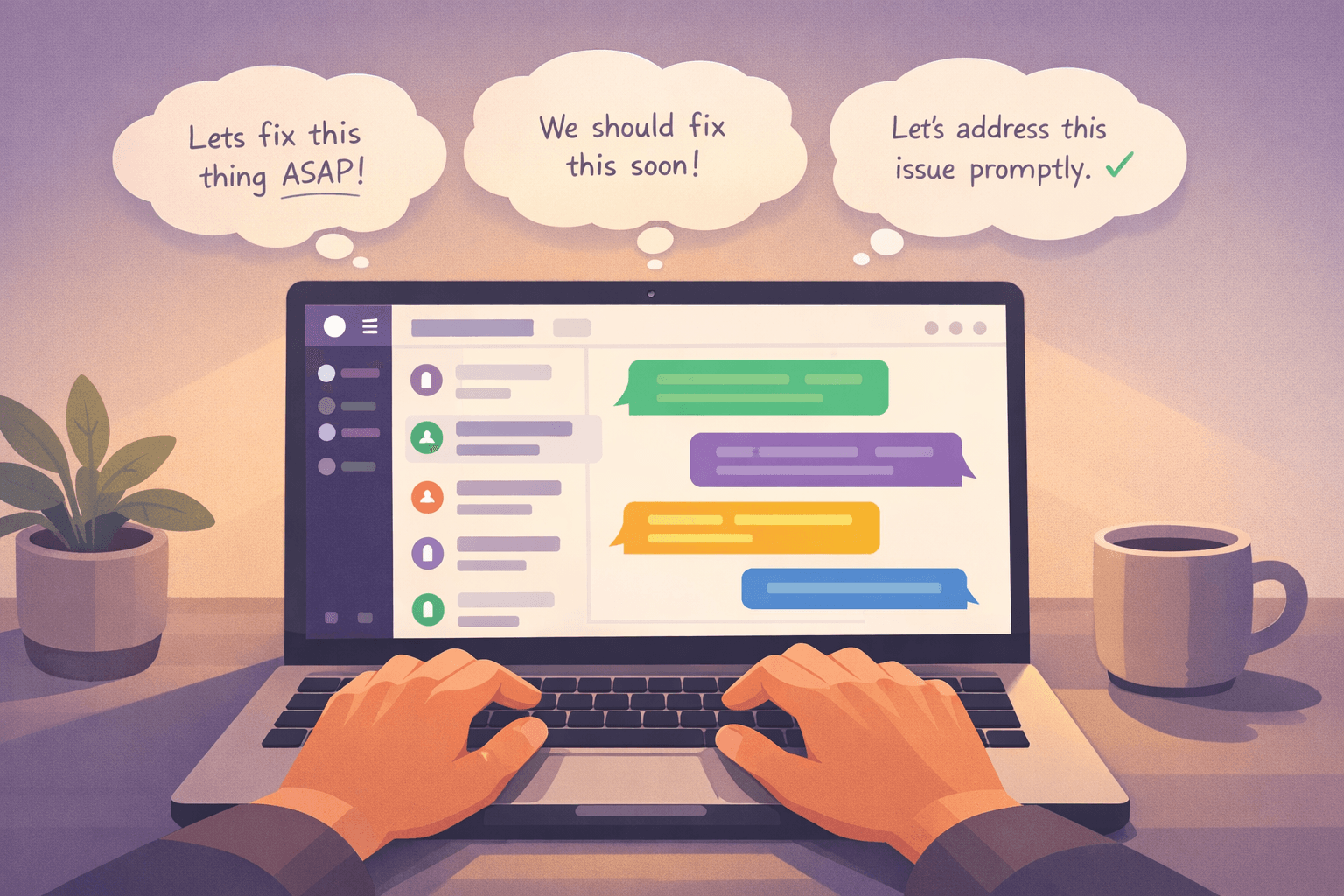
If you've ever stared at a Slack message for five minutes wondering if it sounds "right," you're not alone. For millions of remote workers who use English as a second language, async communication is one of the hardest parts of the job — not because the work is difficult, but because writing in a language that isn't your own adds an invisible layer of friction to every interaction.
In a video call, you can smile, nod, and use your tone of voice to fill in the gaps. In Slack, all you have is text. And that text has to carry your professionalism, your personality, and your intent — all at once.
Here's how to navigate it.
Why async messaging is harder than it looks
When you communicate asynchronously, your message has to stand on its own. There's no body language, no immediate feedback, no chance to clarify in real time. For non-native speakers, this creates a unique set of challenges:
- Tone is invisible. A message that sounds perfectly normal in your head might come across as blunt or cold in English.
- Formality is tricky. Different cultures have different norms around workplace communication. What feels polite in one language might feel stiff or distant in English.
- There's no "undo." Once you hit send, the message is there for everyone to read and interpret.
The good news? You don't need perfect English to communicate professionally. You just need a few strategies.
Common mistakes (and how to fix them)
Being too formal
Many non-native speakers default to overly formal language because it feels "safer." But in most remote teams, especially startups and tech companies, this can actually create distance.
Too formal: "Dear Mr. Johnson, I would like to respectfully request your feedback on the attached document at your earliest convenience."
Just right: "Hey Mike, could you take a look at this doc when you get a chance? Would love your feedback."
The key is to match the tone of your team. Pay attention to how your colleagues write and mirror their level of formality.
Being too direct
In many languages, directness is valued. But in English workplace culture, especially in written form, very direct messages can sound harsh.
Too direct: "This is wrong. Fix it."
Better: "I noticed something off in this section — could we take another look at it together?"
Adding softeners like "I think," "maybe," "could we," or "it seems like" goes a long way.
Unclear tone
Without emojis or context, neutral messages often read as negative. This is true for native speakers too, but it's amplified when you're writing in a second language.
"OK."